The Big Question: What Happens When Your Home Burns Down?
Picture this: A wildfire rips through your neighborhood in the Santa Cruz Mountains. Or maybe a kitchen fire devastates your home in the Inland Empire. It’s a nightmare scenario, of course. But once the smoke clears, a different kind of anxiety sets in: How will you rebuild? Will your insurance company pay enough to put everything back the way it was?
The short answer is you get money. The *real* answer, though, depends entirely on your home insurance policy. Specifically, it hinges on two key terms you might have seen but never quite understood: Replacement Cost Value (RCV) and Actual Cash Value (ACV). These aren’t just technical jargon. They’re the difference between getting a brand-new start and facing a massive financial shortfall.
For most California homeowners, understanding this distinction isn’t just a good idea; it’s absolutely essential. Especially now. The state’s insurance market feels like it’s on shaky ground. Premiums jumped 40% between 2022 and 2024 for many. Insurers like State Farm and Farmers have pulled back from writing new policies in some areas. This makes every line item on your policy matter more than ever.
Replacement Cost Value: The Gold Standard (Mostly)
Let’s start with Replacement Cost Value, or RCV. Think of this as the “new for old” coverage. If your roof is destroyed, an RCV policy pays to replace it with a brand-new roof of similar quality, *without* deducting for wear and tear. If your entire house burns down in, say, the foothills near Chico, your RCV policy aims to give you enough money to rebuild that house from the ground up, using current materials and labor costs.
This is what most people *think* they have, and honestly, it’s what you probably *want* to have. Rebuilding a house in Malibu or even the Santa Clarita Valley today costs a fortune. Lumber prices shot up 300% during the pandemic, remember? And while they’ve come down some, construction costs generally keep climbing. Finding skilled labor after a major disaster? Contractors are booked solid for months, sometimes years, after a big fire, driving up prices even further. RCV tries to account for this reality. It’s about getting you back to where you were before the loss, without having to dig into your own savings for depreciation.

Coinsurance and Underinsurance: A Nasty Surprise
But here’s where it gets interesting. Even with RCV, there’s a catch: coinsurance. Most RCV policies require you to insure your home for at least 80% (sometimes 90% or 100%) of its total estimated replacement cost. If you don’t, and you have a partial loss, the insurer won’t pay the full cost of repairs. They’ll only pay a percentage, leaving you to cover the rest.
Imagine your home’s actual replacement cost is $500,000, but you only insured it for $300,000. That’s 60% coverage. If a fire causes $100,000 in damage, your insurer won’t pay the whole $100,000. They’ll apply a formula, and you could end up with a much smaller check. It’s a tough lesson many learn the hard way.
Which brings up something most people miss. Your home’s market value – what it would sell for in the Bay Area, for example – is often completely different from its replacement cost. A house in San Francisco might sell for $2 million, but rebuilding it could cost $800,000. Conversely, an older, smaller home in a less desirable area might sell for $400,000, but rebuilding it with modern codes and materials could easily hit $600,000. That’s why simply insuring for your home’s sale price is a huge mistake.
Many policies offer “extended replacement cost” as an add-on. This gives you an extra cushion, often 20-50% above your stated dwelling coverage amount, to account for unexpected spikes in construction costs after a widespread disaster. In California, with our history of wildfires and other catastrophes, this isn’t a luxury; it’s almost a necessity.
Actual Cash Value: The Discount Deal (But With a Catch)
Now, let’s talk about Actual Cash Value, or ACV. This is the “used for old” coverage. An ACV policy pays the replacement cost of an item, minus depreciation. Depreciation, in simple terms, is how much something has lost value due to age, wear, and tear.
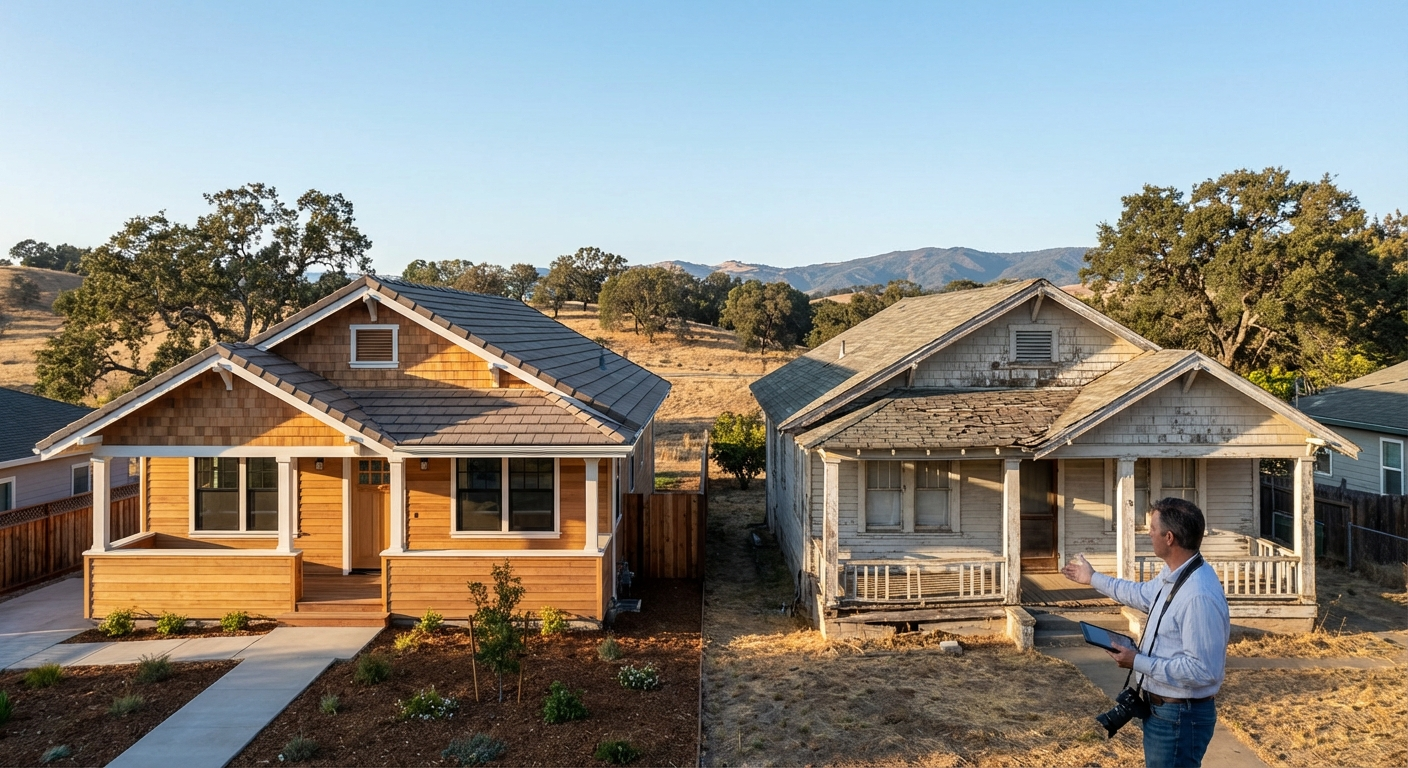
Think of it like buying a used car. That 15-year-old roof in Ventura County? It’s probably only worth half its original value on paper, maybe less. If a storm tears it off, an ACV policy would only pay you that depreciated value, not the cost of a brand-new roof. The same goes for your old carpet, your appliances, or even parts of your home’s structure.
ACV policies are almost always cheaper than RCV policies. That’s because the insurance company takes on less risk. They’re not promising to replace everything new. For some older homes, or for specific items, an ACV policy might be the only option available, especially in high-risk areas where insurers are tightening their belts.
But wait — while saving money on premiums sounds good, the potential out-of-pocket costs with ACV can be astronomical. If your entire home is destroyed, you’d receive a check for its depreciated value. Good luck rebuilding a new home with that. Most homeowners find themselves drastically underfunded, having to take out loans or scale back their rebuilding plans significantly.
Why California Homeowners *Really* Need to Pay Attention
California’s insurance market is unique, to say the least. We’ve seen major insurers like State Farm and Farmers scale back, and others like AAA and Mercury adjust their offerings. This isn’t just about higher premiums; it’s about *availability* of coverage.
The constant threat of wildfires in places like Paradise, Sonoma County, or the foothills of the Sierra Nevada means insurers are incredibly cautious. After the 2018 Camp Fire, many homeowners found themselves wildly underinsured, even with RCV policies, because the cost to rebuild soared beyond anyone’s estimates. The sheer demand for contractors and materials after such a widespread event made it impossible for many to rebuild without significant personal expense.
If you can’t find traditional RCV coverage, you might end up with the California FAIR Plan. It’s a state-mandated program that acts as an insurer of last resort. It’s a safety net, for sure, but it often provides more basic coverage, sometimes defaulting to ACV for certain items or having lower limits. It’s better than nothing, but it’s not always the comprehensive coverage you’d get from a private insurer. Prop 103, which regulates insurance rates in California, has also played a role in the market’s current state, making it harder for insurers to raise rates quickly enough to keep up with rising risks and costs.
It’s Not Just Your House: What About Your Stuff?
Your personal property – everything from your furniture and clothes to your electronics and kitchen gadgets – also falls under RCV or ACV rules. Most standard home insurance policies actually default to Actual Cash Value for personal belongings.
Think about it: That 10-year-old flat-screen TV? Under ACV, it’s worth pennies. Your five-year-old couch? Same story. If a fire destroys all your possessions, an ACV policy would leave you with a fraction of what it would cost to replace everything new.
However, you can almost always upgrade your personal property coverage to Replacement Cost Value. This means if your belongings are destroyed, your insurer will pay to replace them with new items of similar quality. It costs a bit more, naturally, but it offers far greater peace of mind. For most people, it’s an upgrade well worth considering.
Getting the Right Number: Your Agent Matters
Determining your home’s true replacement cost isn’t a simple calculation you can do with an online tool. It requires understanding local construction costs, building codes, material prices, and labor availability. This is where an experienced insurance agent becomes absolutely invaluable.
An agent like Karl Susman of Los Angeles Home Insurance Quotes (CA License #OB75129) understands the nuances of the California market. They don’t just quote you a price; they help you assess your home’s unique characteristics, factoring in things like custom finishes, the slope of your property, or the specific fire-resistant materials required in your area. They’ll use specialized software and their market knowledge to arrive at a realistic replacement cost estimate. Your agent isn’t just selling you a policy; they’re helping protect your biggest asset.
Ready to sort out your coverage? Get a personalized quote and talk to an expert who knows California insurance inside and out. Get a Quote Today
Common Misconceptions About Your Home’s Value
Many homeowners carry some common, but dangerous, misconceptions about their insurance coverage.
One big one: “My home’s market value is the same as its rebuild cost.” Not always. As we discussed, these are very different numbers, and confusing them can lead to massive underinsurance.
Another myth: “My policy automatically pays to rebuild everything new.” Unless you specifically have RCV coverage for your dwelling and personal property, this isn’t true. Many policies have limits or default to ACV for certain items.
And finally: “ACV is ‘good enough’ because it’s cheaper.” While the lower premium is tempting, the financial risk you’re taking on with ACV, especially for your dwelling, is enormous. It’s a gamble most homeowners can’t afford to lose.
Don’t leave your biggest asset to chance. Get a personalized quote today and ensure your coverage truly protects what matters most. Protect Your Home Now
Frequently Asked Questions About California Home Insurance
Does my policy cover wildfires in California?
Yes, standard home insurance policies in California typically include coverage for fire, including wildfires. However, finding a policy in high-risk areas can be challenging, and some insurers have stopped writing new policies in certain regions. The California FAIR Plan can provide basic fire coverage if you can’t find it elsewhere, but it often requires additional policies for other perils.
What if I can’t find RCV coverage in my area?
If private insurers aren’t offering RCV coverage in your specific California location, you might need to turn to the California FAIR Plan for fire coverage. It’s a crucial backstop. However, FAIR Plan policies often have limitations and may not offer full RCV for all aspects of your home or personal property. You’d then need to purchase a “Difference in Conditions” (DIC) policy from a private insurer to cover perils like liability, theft, and sometimes to upgrade to RCV for personal property.
How often should I review my replacement cost?
You should review your home’s replacement cost annually with your insurance agent. Construction costs, labor rates, and building codes can change rapidly, especially in California. Also, if you’ve done any major renovations or additions to your home, it’s essential to update your coverage immediately to reflect the increased value and rebuild cost.
Is earthquake damage covered by my home insurance?
No. Standard home insurance policies in California do not cover earthquake damage. Earthquake coverage is a separate policy you must purchase, typically from the California Earthquake Authority (CEA) or a private insurer. It’s a critical consideration for many parts of the state.
This article is for informational purposes only and does not constitute financial advice.